How skateboard decks are made: veneer to finished board
See how maple skateboard decks move from veneer selection and glue-up through pressing, machining, sanding, finishing, graphics and quality control.
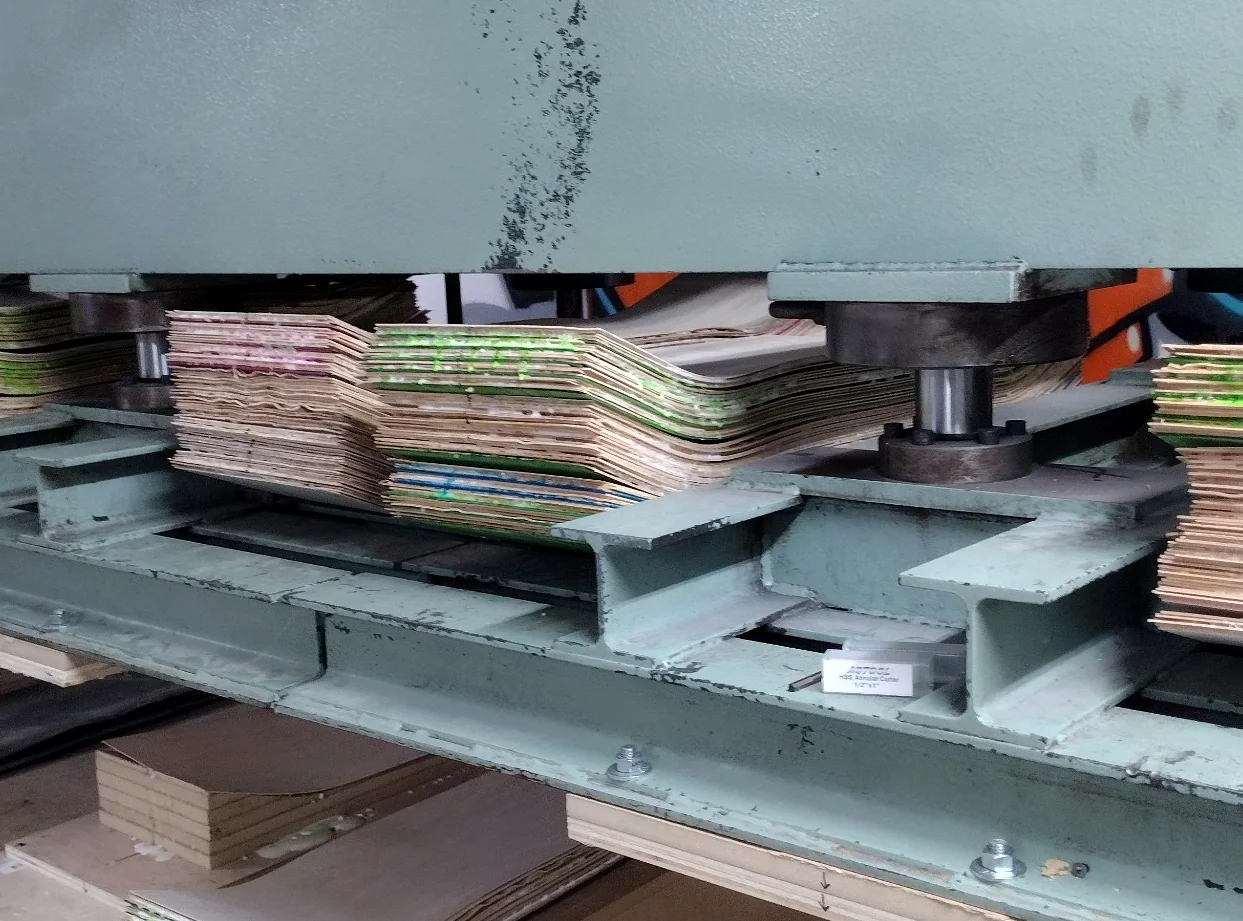
1. Start with skateboard-grade maple
A production deck begins with thin maple veneer rather than a single thick board. The sheets are sorted by type and grain direction so the layup can combine outside faces, long-grain cores and crossbands. Natural and dyed veneer can be mixed, but the structural position of each sheet still matters.
2. Build and glue the layup
The veneer is stacked in the specified order and adhesive is applied between layers. Coverage, working time and alignment have to be controlled well enough that the stack can reach the mold before the glue progresses too far. Consistency here affects every later operation.
3. Press the deck in a mold
The glued layup is placed into tooling that creates the concave, kicks and overall three-dimensional form. Pressure holds the stack against the mold while the adhesive cures. Once released, the deck is still an oversized uncut rather than a finished skateboard shape.
4. Drill and machine the perimeter
The truck-hole pattern and final perimeter have to be located relative to the pressed geometry. Production fixtures and CNC machining help keep wheelbase, width and shape repeatable. The deck is then routed and edge-worked to remove the sharp laminated perimeter.
5. Sand and prepare the surface
Machining leaves a deck that still needs sanding and surface preparation. The exact sequence depends on whether the board will remain natural, receive a dyed finish, be clear coated, or continue into a graphic application.
6. Finish and print
Blank decks can stop after sanding and finishing, while branded production continues through a compatible graphic process such as heat transfer or screen printing. Artwork, underbase, coating and physical samples should be approved as a system rather than as separate assumptions.
7. Inspect, pack and retain the production spec
A repeatable manufacturer records the approved construction, shape, wheelbase, finish and graphic details so reorders do not start from zero. Quality control is not only checking one finished deck; it is protecting the specification across the batch.
How skateboard decks are made: veneer to finished board FAQ
How many layers are in a skateboard deck?
Seven-ply maple is a common reference construction, but specialty decks may use other ply counts depending on the intended stiffness, thickness and application.
Are skateboard decks made from one piece of wood?
No. Most wood skateboard decks are laminates made from multiple thin veneer sheets bonded and pressed together.
When is the skateboard shape cut?
The deck is normally pressed as an oversized uncut first, then drilled and machined to the final perimeter after pressing.
Can a factory make blank decks without graphics?
Yes. A manufacturer can stop at an uncut, shaped blank, sanded blank, sealed blank or print-ready stage depending on the order.